History of Lonaconing
Lonaconing was developed in the 1830s as a company town for the George’s Creek Coal and Iron Company. By 1881, Lonaconing’s Main Street had become the commercial core of a thriving town. On September 7, 1881 a fire destroyed most of the commercial district. Soon after the fire, the current downtown streetscape began to develop over the ruins of the burnt town center. The George’s Creek Coal and Iron Company was founded in 1837, with one furnace operating between 1837 and ca. 1855. At its height (1837-1844), the furnace operation employed about 260 people, turned out 60 to 75 tons of pig iron per week, and cast items such as stoves, farm tools, and hardware for the C & O Canal. However, competition from cheaper imported iron and the inaccessibility of the works rendered continued iron production unprofitable. After ceasing furnace operations, the company concentrated entirely on producing coal.
Lonaconing was the company’s principal town and by the mid-1850s, it already had become a complex village that clustered along George’s Creek and its main thoroughfare. The ca. 1839 map depicts significant buildings, including the company’s blast furnace, warehouse, sawmill, and what is likely the superintendent’s house. Smaller structures, likely worker’s housing, occupied steep slopes overlooking the creek valley. Also portrayed on the map was a mill race that provided power for both the blast furnace and sawmill.
Historical Sites
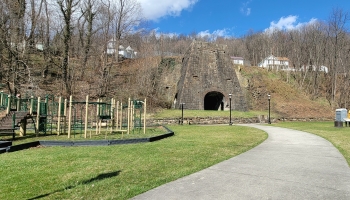
Iron Furnace & Park
- Built in 1837 by the George’s Creek Coal and Iron Company, the Iron Furnace was the first in the United States to successfully use coal and coke fuel rather than charcoal to produce pig iron. The massive furnace produced nearly 75 tons of iron per week at its height of production. The furnace, used to make dowels for the C&O Canal’s lock walls, is listed on the National Register of Historic Places. Also, enjoy the family park while visiting.
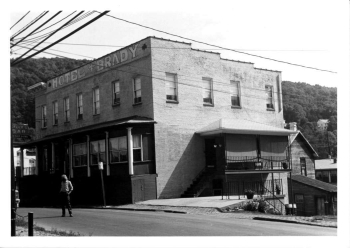
Lonaconing Historic District
- The Lonaconing Historic District comprises 278 buildings and structures consisting of a variety of 19th and early-20th century commercial, industrial, and residential buildings which attest to the development of Lonaconing as a center of the iron, coal, and silk industries in the George’s Creek Valley of Western Maryland. The focus of the district is a group of 40 late-19th and early-20th century commercial structures lining Main Street and intersecting streets, including a hotel, bank, three dry goods stores, and numerous other shops and warehouses, mostly constructed after a fire that devastated downtown in 1881. The Historic District is listed on the National Register of Historic Places.